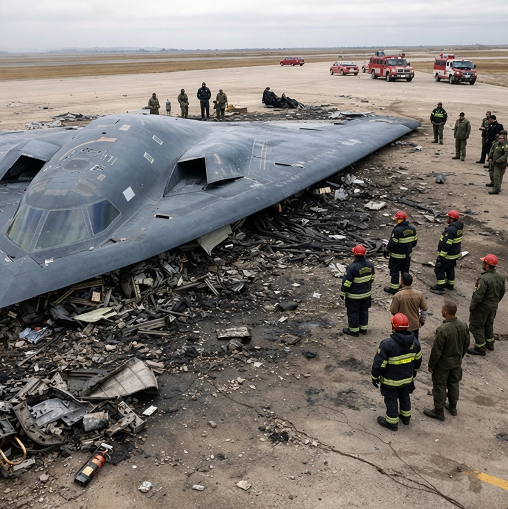
B-2 Spirit stealth bomber, focusing on its design, operational history, and the widespread myth that one has ever been shot down in combat. It argues that this claim is not supported by any verified evidence and is instead the result of misinformation, confusion, and the aircraft’s secretive nature.
The B-2 Spirit, developed by Northrop Grumman for the United States Air Force, is presented as one of the most advanced strategic bombers ever built. Designed during the Cold War, it was created to penetrate heavily defended enemy airspace using stealth technology rather than speed or armor. Its distinctive flying-wing shape, radar-absorbing materials, and carefully engineered structure all contribute to its low observability. The aircraft’s primary mission is long-range precision strikes against high-value targets, often deep within hostile territory.
Because of its stealth capabilities and limited public visibility, the B-2 has become highly mysterious to the public. This secrecy, combined with its technological sophistication, has contributed to speculation and myths about its performance in combat, including repeated claims that one has been shot down. The text emphasizes that no credible evidence supports such claims and that official United States Air Force records confirm that no B-2 has ever been lost due to enemy action.
Instead, all known incidents involving the aircraft have been accidents or technical failures. The article highlights that these events are sometimes misinterpreted or exaggerated, leading to false narratives about combat losses.
One major documented incident occurred in 2008 at Andersen Air Force Base in Guam. In that case, moisture contamination in the aircraft’s air data sensors caused incorrect readings during takeoff, leading to a stall shortly after lift-off. The aircraft was destroyed, but both crew members ejected safely. The investigation confirmed that the crash was caused entirely by a technical malfunction, not hostile activity.
Another incident referenced occurred in 2021 at Whiteman Air Force Base, where a B-2 sustained damage during a landing operation. Although details were limited for security reasons, officials confirmed there was no combat involvement. The investigation focused on maintenance and operational improvements rather than any external threat.
The text explores why myths about a B-2 shootdown persist. One key factor is secrecy: because much of the aircraft’s operational use is classified or not publicly visible, gaps in information allow speculation to spread. Another factor is confusion with other aircraft, particularly the F-117 Nighthawk, which was indeed shot down in 1999, leading some to incorrectly attribute similar events to the B-2. Sensational online content also plays a major role, as dramatic claims tend to spread more widely than technical corrections.
The article also distinguishes clearly between accidents and combat losses. Accidents result from technical failures or human error, while combat losses occur due to enemy action. This distinction is important because it affects how aircraft performance and survivability are understood. In the case of the B-2, all documented losses fall into the accident category.
Finally, the text emphasizes the importance of verified information and responsible reporting. It concludes that the B-2 Spirit remains one of the most successful stealth aircraft ever built, with no record of being shot down in combat. Its operational history, while occasionally marked by accidents, reflects technological complexity rather than vulnerability to enemy fire.
Overall, the passage aims to correct misconceptions, reinforce verified facts, and explain why myths about the B-2 continue to circulate despite the absence of evidence.